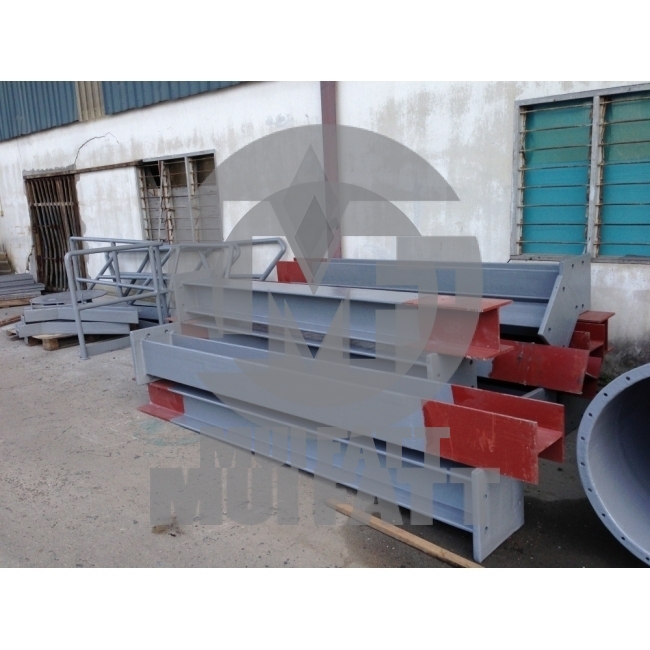
FRP Lamination for Coastal and Offshore Steel Structures
FRP lamination as a protective coating for coastal and offshore metal structures exposed to sea air and salt water. ISO or vinyl ester resin with glass mat plies and a waxed topcoat, on site or at our factory.
FRP Lamination for Coastal and Offshore Steel Structures
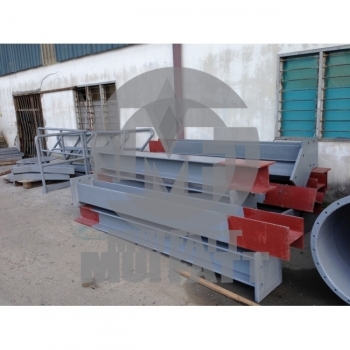
FRP lamination can be used as a protective coating on coastal and offshore metal structures exposed to sea air and salt water. The lining is built up by hand from resin primer, plies of glass mat, a surface veil and a waxed topcoat, bonded to the steel in one seamless layer. Mui Fatt uses isophthalic polyester (ISO) or vinyl ester (VE) resin for this work, on site or at our factory in Port Klang.
Ringkasan: Lapisan fiberglass (FRP) sebagai salutan pelindung untuk struktur logam di kawasan pantai dan luar pesisir yang terdedah kepada udara laut dan air masin. Resin ISO atau vinyl ester. Kerja dibuat di tapak atau di kilang kami di Pelabuhan Klang.
Specifications
| Substrate | Steel and other metal structures exposed to sea air and salt water |
|---|---|
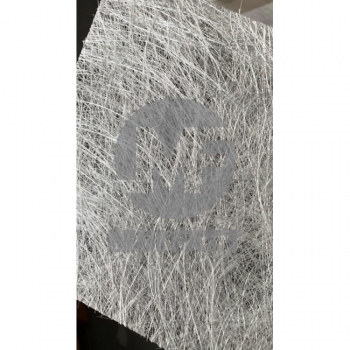
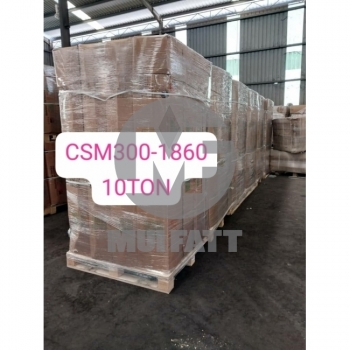
| Lining build-up | 1 coat of resin primer; plies of 450 g/m² E-glass chopped strand mat (CSM); 1 ply of surface veil; 1 coat of waxed resin topcoat |
| Number of plies | Minimum 1 ply recommended; usually up to 3 plies |
| Lining thickness | About 1 mm per ply, so usually about 1 mm to 3 mm |
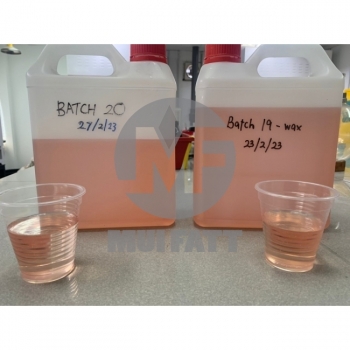
| Resin | Isophthalic polyester (ISO) or vinyl ester (VE) |
| Colour | Natural resin colour (clear) or grey |
| Typical properties | Tensile strength 9,000 psi; tensile modulus 1,000,000 psi; Barcol hardness above 30; adhesion above 580 psi on grit-blasted steel |
| Inspection | Visual inspection for blisters, cracks, trapped air and irregularities; ply count during lamination |
| Work site | On site, or send the parts to our factory in Port Klang |
How we laminate steel
- Site visit: our technical staff check the steel, and access for workers, before work starts.
- Surface preparation: the steel is ground to remove rust, and dust is removed.
- Priming: one coat of resin primer by brush or roller, left about 1 to 2 hours until tacky.
- Lamination: each ply of glass mat is laid into wet resin, wetted through and rolled to remove trapped air, then the surface veil. Each stage is touch dry in about 3 to 4 hours.
- Topcoat: a resin-rich waxed topcoat, left to cure about 12 hours.
- Inspection: visual inspection for blisters, cracks and trapped air, with the plies counted as they are laid.
We work at 10°C to 50°C, relative humidity below 90%, with the surface at least 3 K above dew point, and not in rain.
No welding or metal cutting may take place near or above the lining area.
Why FRP rather than paint
An FRP lining is glass reinforced and millimetres thick, while a paint coat is a thin unreinforced film. The glass mat bridges small cracks, and the plies overlap into one continuous layer. A paint coat costs less and is faster to apply, and may be enough for dry, mild conditions.
Care and repair
Inspect the lining regularly. A hard knock or a pinhole lets salt water reach the steel, and corrosion can then spread under the lining. We repair and reline old FRP linings.
Other FRP lamination pages
- FRP Lamination for Steel Structures →
- FRP Lamination (FRP Lining) Service →
- FRP Lamination for Mild Steel and Stainless Steel Tanks →
- All FRP Lamination Products →
Questions About Coastal and Offshore Lamination
Can you do the work on site?
Yes. We laminate on site, or you can send the parts to our factory in Port Klang.
Which resin do you use?
Isophthalic polyester (ISO) or vinyl ester (VE). We advise on the resin and the number of plies before we quote.
Berapa harga salutan FRP untuk struktur keluli di tepi laut?
Hubungi kami untuk harga terkini. Harga bergantung pada keluasan permukaan, bilangan lapis dan jenis resin.
Contact Mui Fatt for a quotation: Get a Quote →